








A new Talkspace study reveals a quiet relational earthquake happening inside American families — and moms are right at the center of it.
If you’ve ever muted a group chat full of in-laws, quietly unfollowed a “mom friend” who made you feel small, or stopped answering your sister’s texts after one too many backhanded comments — you’re not alone. Not even close.
A new study commissioned by Talkspace and conducted by Talker Research surveyed 2,000 Americans and found that 38% have gone “no contact” with a friend or family member in the last year. And for younger adults — the very people raising today’s kids — that number climbs dramatically.
Here’s what the data reveals, why it matters for moms and families, and what experts say healthy connection should actually look like.
The Numbers: A Generational Shift in How We Handle Relationships
The survey uncovered a clear generational divide in how Americans are managing difficult relationships.
In the last 12 months:
- 60% of Gen Z have gone no contact with a friend or family member
- 50% of millennials have done the same
- 38% of Gen X have cut someone off
- 20% of baby boomers have walked away from a relationship
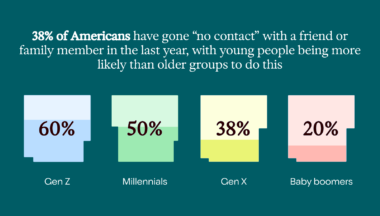
In other words, the parents of young kids right now — millennials and older Gen Z — are the most likely generation in history to end a relationship rather than try to repair it. That shift shows up in how families function, how moms build (or don’t build) their support systems, and how kids are learning to handle conflict.
Why People Are Walking Away
When researchers asked why respondents went no contact, the answers painted a picture of relationships stretched past their breaking point.
The top reasons Americans gave for cutting someone off:
- They weren’t respectful to me — 36%
- The relationship negatively impacted my mental health — 29%
- They were too negative in general — 27%
- Their values differed too much from mine — 24%
- I outgrew the relationship — 19%
- We disagreed about politics or social issues — 19%
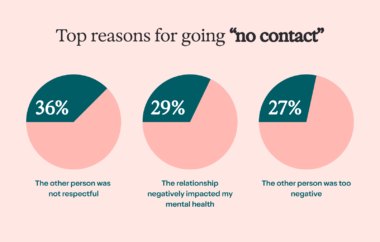
For moms, these categories likely feel familiar. Mental load is already crushing, and a relationship that adds judgment, criticism, or emotional chaos on top of parenting is often the first thing to go.
It’s Not Just “No Contact” — It’s a Whole New Playbook
Going no contact is the headline, but it’s only one tool in a much bigger toolbox of quiet exits. In the last year, Americans have also:
- Unfollowed a friend or family member on social media — 41%
- Blocked a friend or family member on social media — 36%
- Left a group chat because of an issue with someone in it — 32%
- Formally ended a relationship with a friend or family member — 31%
- Removed a friend or family member from a group chat — 30%
These aren’t dramatic blowups. They’re silent exits — and they’re happening all around us.
The Real Problem: We’re Avoiding Instead of Communicating
Here’s the stat that should make every parent pause. Nearly three-quarters of Americans (73%) said they feel inclined to distance themselves when a relationship gets hard — rather than openly communicating to problem-solve.
And once someone is cut off, the door often stays closed. 59% of people who went no contact in the last year are still not in touch with that person.
Dr. Nikole Benders-Hadi, Chief Medical Officer at Talkspace, put it this way:
“These results suggest that avoiding relationship challenges is becoming more common, but that approach can come with its own risks, making it harder to sustain meaningful connections over time and leading to more loneliness. Prioritizing communication, setting healthy boundaries and staying engaged even when it’s uncomfortable can help people preserve the relationships that support their mental wellness.”
In a season of life when moms need community the most, the cultural default is becoming the exact opposite of connection.
The Loneliness Epidemic Is Real — And Moms Feel It
The data confirms what so many moms already whisper about:
- 47% of Americans experience loneliness during a typical day
- 34% feel less socially connected than they did five years ago
- 68% say they struggle to build in-person community
The top reasons people gave for struggling to connect in real life?
- Social anxiety — 30%
- Preferring to spend time alone — 30%
- Feeling like they don’t fit in with those around them — 26%
If you’ve ever sat in school pickup and felt invisible, or cancelled a playdate because the thought of small talk felt like too much — the data says you are squarely in the majority.
We’re Also Avoiding Strangers (And the Tech Helps)
It’s not just family and friends. Americans are using technology to opt out of everyday human contact. Survey respondents said they use:
- Online ordering — 68%
- Self-checkout kiosks — 64%
- Chatbots and automated help systems — 42%
- Autonomous taxis or rideshares — 24%
…specifically to reduce interaction with other people. And it gets more telling:
- 37% would rather fake a phone call than have two minutes of small talk with a stranger
- 40% would rather cross the street than stop and chat with someone they know for five minutes
Gen Z — today’s newest parents — led both of those numbers. The generation raising babies right now is the generation most likely to actively avoid human contact.
The Good News: People Want Community — They Just Don’t Know Where to Start
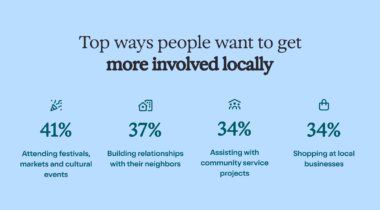
Here’s the hopeful part of the data. Even though 41% of Americans said they’re uninvolved in their local community, 31% said they actually want to be.
The top ways people said they’d love to get more involved:
- Attending local festivals, markets, and cultural events — 41%
- Building relationships with their neighbors — 37%
- Assisting with community service projects — 34%
- Shopping at local businesses — 34%
For Orlando moms, this is a love letter. Our city is stuffed with festivals, farmers markets, splash pads, library events, and small businesses begging for foot traffic. The desire for connection is there — the first step just has to be small.
What a Healthy Relationship Actually Looks Like
Before you write off every complicated relationship in your life, it’s worth looking at what respondents said they want out of the connections they keep.
Americans said a relationship feels healthy when:
- I feel safe enough to voice my thoughts and opinions — 47%
- We celebrate each other’s successes — 41%
- I feel seen and understood — 41%
- There is consistency and reliability — 41%
- My boundaries are respected — 41%
- Time spent together is energizing — 39%
- We can apologize and repair after conflicts — 38%
- My time is valued — 37%
Read that list again as a mom. How many of your current relationships — including the ones you haven’t cut off — actually hit those marks? And how many of your closest connections would say you hit those marks for them?
That’s the real work.
The Takeaway for Moms
The headline says 38%, but the deeper story is this: an entire generation is quietly deciding that walking away is easier than working it out. And for moms — who are already stretched thin and desperate for real support — the cost of that default is steep.
Going no contact is sometimes necessary. Truly toxic, abusive, or unsafe relationships should be ended, full stop. But the data suggests we’re also cutting off people we could have repaired with — and the loneliness that follows isn’t an accident.
The antidote isn’t dramatic. It’s the hard, unglamorous work of:
- Saying the uncomfortable thing out loud instead of ghosting
- Setting a real boundary instead of a silent one
- Showing up at one local event this month, even if you’d rather stay home
- Being the friend to other moms that you wish you had
Because the community you want is built one awkward, inconvenient, real-life conversation at a time.
What do you think? Have you gone no contact with someone this year — or had someone go no contact with you? Tell me your story in the comments. Another mom needs to read it.
Source: Survey of 2,000 general-population Americans, commissioned by Talkspace and conducted by Talker Research between March 20–23, 2026, for Mental Health Awareness Month.