






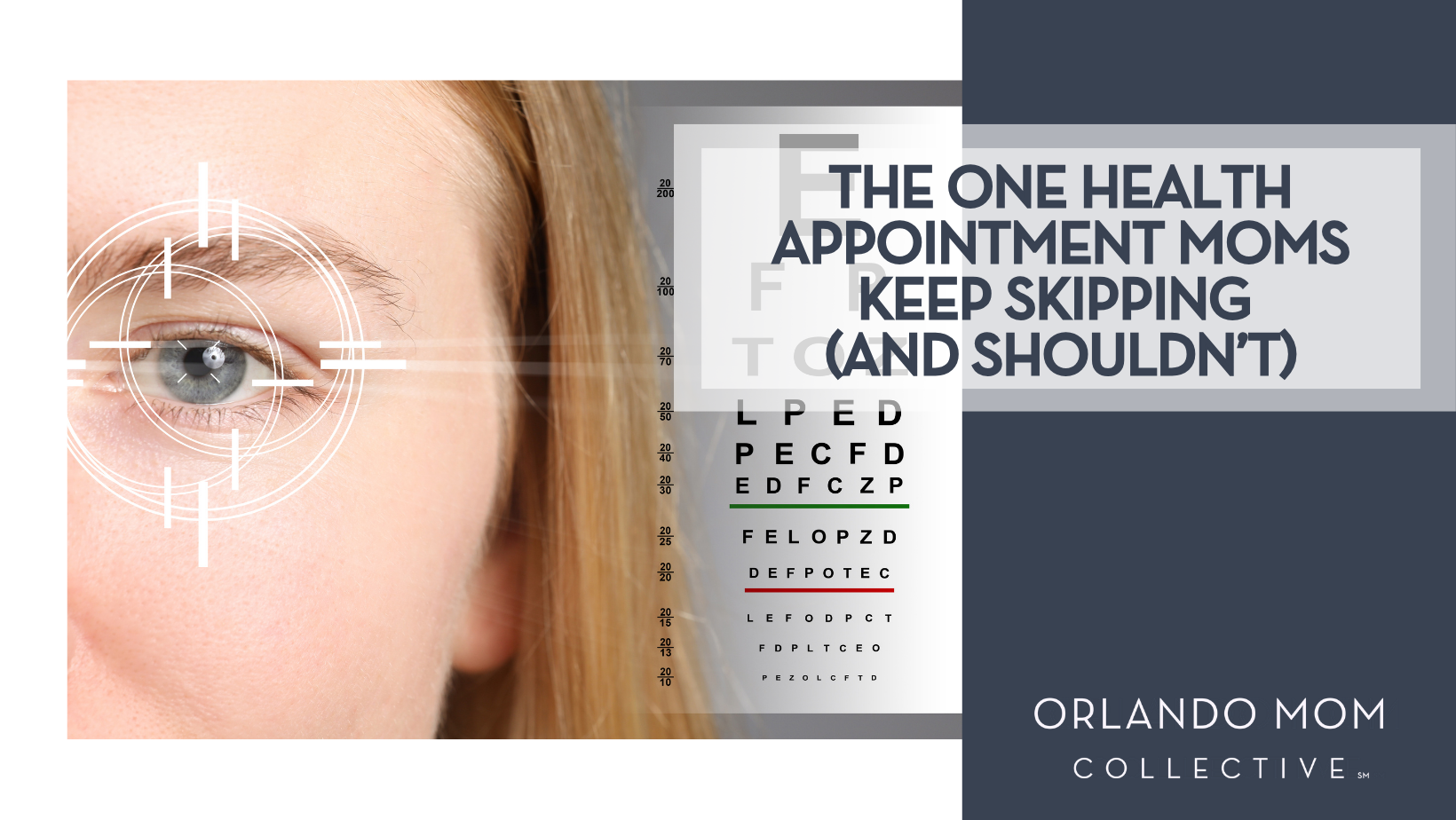


Quick, mom-to-mom honesty check: when was the last time you had your eye exam?
Not your kid’s annual back-to-school exam. Not the vision screening at the pediatrician. Not the time you squinted at the menu board at the drive-thru and silently wondered if you needed readers. I mean an actual, sit-in-the-chair, “now which is better, one or two” eye exam — for you.
If you just laughed nervously and tried to do the math in your head, congratulations. You have lots of company.
The Survey That Called Us All Out
A new survey of 2,000 American adults — conducted by Talker Research on behalf of the American Optometric Association (AOA) — found that more than 1 in 5 Americans (22%) haven’t been to the optometrist in at least a year, and another 15% literally cannot remember the last time they went. As in, “I think it was before the kids were born?” energy.
It gets better (or worse, depending on how guilty you’re feeling reading this):
- 20% haven’t had an actual eye exam in over a year
- 11% can’t remember the last one
- Gen Z is the most likely to have put it off (24%) — sorry, Zoomers
Meanwhile, the average American is staring at screens for nearly 50 hours a week. Seven hours a day. Gen X is winning that contest at 52 hours weekly. That adds up to over 2,500 hours of screen time a year per person.
Two thousand five hundred hours. Per person. And we are doing exactly nothing about our eye health, on average.
We Care About Health… Just Not THAT Part
Here’s the contradiction that made me sigh out loud: 91% of people say they care about preventative health. But only 55% actually commit to annual exams.
What ARE we doing instead?
- Taking vitamins and supplements (64%)
- Eating healthy foods (61%)
- Exercising regularly (56%)
All beautiful things! All things I also try to do in between school pickup and dinner! But when researchers asked which areas of health people prioritize, eye health came in WAY down the list:
- Mental health: 61%
- Emotional health: 32%
- Oral health: 21%
- Eye health: 20%
We will floss. We will go to therapy. We will side-eye our own emotional regulation in the rearview mirror at carpool. But the actual eyes we use to do all of those things? Eh, they’ll be fine. Probably. Right?
Momma, they may not be fine.
What an Eye Exam Can Actually Catch
Here’s the wake-up call buried in this study: 22% of Americans had no idea that a comprehensive eye exam can reveal bigger health issues. A real eye exam isn’t just “do you need glasses.” It can flag early warning signs of all kinds of things — diabetes, high blood pressure, autoimmune conditions, even certain cancers.
“More than a quarter of Americans say they’ve had an eye health ‘wake-up call’ that led them to seek care,” said Dr. Jacqueline M. Bowen, president of the AOA. “That tells us many people are waiting until something feels wrong before seeing an optometrist. In reality, changes in eye health can happen gradually and without clear symptoms, which is why routine, comprehensive eye exams are so important for catching eye health issues, and over 270 diseases, earlier.”
Two hundred and seventy diseases. That an optometrist can help spot. Just by looking in your eyeballs once a year.
Two years ago, at my annual eye exam, my eye doctor discovered a form of glaucoma that usually isn’t found until your early 60s. This was only because he does different kinds of tests that are available in his office that I always opt in for. I specifically have “narrow angles”, which means that I can’t use certain kinds of drops in my eyes and that I have to be very careful when getting my eyes dilated. I would have never known this had I not gone to my annual exam and he discovered what he did.
When researchers asked the people who haven’t been recently why they hadn’t, the top answers were basically:
- “I didn’t think I needed to” (27%)
- “I think my vision is good and I don’t have problems” (22%)
Which, look — I get it. Mom Logic says: if it’s not actively bleeding, broken, or on fire, it goes to the bottom of the to-do list. But “my eyes feel fine” is not the same as “my eyes ARE fine.” And by the time something feels wrong, you may have missed the early window.
I love my eye doctor and I make it a point to see him every year. He does more in-depth and comprehensive testing in addition to your traditional annual eye exam. I’ve made it a priority because I’ve noticed over the years that driving at night is especially difficult without my glasses! Once he discovered my narrow angles, I never skipped my annual exam.
A Section Specifically for the GLP-1 Moms
Now let’s talk about something that’s come up in basically every group chat I’m in this year: GLP-1 medications. You know — Ozempic, Wegovy, Mounjaro, Zepbound. The ones that have completely reshaped how people are approaching weight loss, blood sugar, and a whole bunch of other health stuff.
The survey specifically asked 1,000 GLP-1 users about their eye health habits, and there’s some genuinely important info here that I had no idea about, so I’m passing it along:
- 95% of GLP-1 users say preventative health is important to them (higher than non-users at 88%)
- BUT 1 in 7 still haven’t had an eye exam in the last year
- And 22% of GLP-1 users who haven’t gone said they didn’t think they needed to
Here’s the part I want every mom on a GLP-1 (or thinking about starting one) to hear:
- 56% of people had no idea you should get a baseline eye exam before or shortly after starting a GLP-1
- 52% had no idea there can be eye-related side effects — including 26% of current users
- Only 13% knew that permanent vision loss is a possible (rare but real) complication
- Other lesser-known side effects: gallbladder disease (12% aware), gallstones (10%), and NAION (8%)
“When one in five people using GLP-1 medications report experiencing eye health issues after starting treatment, it shows why it needs to be part of the conversation,” Dr. Bowen said. “Starting with a baseline eye exam and keeping up with regular care from an optometrist is an important part of managing eye health alongside those broader health decisions.”
I’m not here to weigh in on whether anyone should or shouldn’t be on a GLP-1 — that is firmly between you and your doctor. But if you ARE on one, please add “baseline eye exam” to the list. It is apparently “A Thing”, and most people, including a quarter of current users, didn’t know.
A Tiny To-Do List for the Moms Who Made It This Far
If you’re anything like me, you are right now mentally adding “make eye appointment” to a to-do list that already has 84 items on it, and you are quietly hating me for adding to the pile. Fair. But hear me out:
- Pick a time that’s already attached to something. Schedule yours during the same week as your kids’ annual exams. One trip, one mental load, done. This is how I do it every year, and honestly, it’s the only way I will do it moving forward. We both get done at the same time, and I don’t have separate appointments or separate things to remember. It really is a game changer.
- Take stock of your screen time. Seven hours a day is a LOT. We can’t avoid screens entirely (hi, this is a blog post on the internet), but maybe build in a 20-20-20 break — every 20 minutes, look at something 20 feet away for 20 seconds. This is a recommendation from my eye doc and it actually helps.
- If you’re on a GLP-1, ask your prescribing doctor about a baseline eye exam. If you’ve been on one for a while and never had one, ask now.
- Don’t wait for a “wake-up call.” That’s literally the whole point of preventative care.
You Take Care of Everyone Else’s Eye Exam… Take Care of Yours
Listen. We schedule the kids’ eye exams. We replace their broken glasses (twice, because the first pair “fell” off during recess, allegedly). We pack the eye drops, we hold the cold compresses, we drive across town to the pediatric specialist. We are the eye health concierge service for our entire household.
Maybe this is the year we make an appointment for ourselves, too.
Your eyes do a LOT for you, mama. They watch the dance recital from the back row. They read the bedtime stories. They scan the parking lot for your kid in the sea of soccer uniforms. They deserve one hour, once a year. That’s it.
Now if you’ll excuse me, I have my annual appointment to schedule.
Mom pro tip: Every year, I schedule all of my appointments around May. It keeps me consistent in knowing when everything is supposed to happen. Is it a big expenditure all at once? Yes, however, I know everything is done.
Research methodology: Talker Research surveyed 1,000 adults who have taken GLP-1s and 1,000 adults who have never taken GLP-1s, with a minimum of 100 Gen Z and 100 millennials per group. The survey was commissioned by the American Optometric Association and conducted online by Talker Research between March 17 and March 30, 2026. The complete methodology, as part of AAPOR’s Transparency Initiative, is available on the Talker Research Process and Methodology page.