







I want to ask you something, mama, and I want you to answer honestly: When was the last time you actually thought about your tap water?
Not “did I drink enough today?” — but really thought about what’s in it, where it comes from, whether it’s safe, and what it’s doing to your body (and your kids’ bodies) every single day?
If you just blinked at the screen, you’re in good company. A new survey of 2,000 Americans, commissioned by Culligan International and conducted by Talker Research, found that even though 76% of us say we’re more intentional about our health than ever before — and 75% claim to “care a lot” about what goes into our bodies — 35% of us haven’t given a single thought to the quality of our tap water in the last year.
Let me say that again: three out of four Americans care a LOT about what we put in our bodies… but a third of us are completely tuned out on the most foundational thing we put in our bodies multiple times a day.
I’m going to gently call this out because I love this community, and because I went to nutrition school for it.
A Quick Reframe From My IIN Days
When I graduated from the Institute for Integrative Nutrition in 2019, one of the very first lessons drilled into us was this: you can’t out-supplement, out-organic, or out-exercise a polluted foundation. Water is the foundation.
Your blood is mostly water. Your brain is mostly water. Your muscles, your skin, your digestive system, your hormones — all running on the quality of what you drink. So when we talk about wellness, we cannot skip the most basic input.
You can buy all the organic groceries. You can do all the SPF. You can supplement, walk, sleep, meditate, and Pilates your way through the year. But if the water you’re using to brush your teeth, make your coffee, cook your pasta, fill your kid’s water bottle, and hydrate yourself isn’t clean? You’re chasing wellness uphill.
This is especially true here in Central Florida, where it’s HOT, we’re outside, the kids are sweating through three water bottles a day at the baseball field, and water consumption is sky-high year-round.
The Survey Findings That Stopped Me Cold
Per the Talker Research / Culligan study, here’s where most of us are quietly getting it wrong:
- 51% believe water that meets government regulations is fine to drink — but 70% misunderstand what “regulated water” actually means
- 80% didn’t know arsenic could be hiding in tap water
- 79% didn’t know about nitrates
- 74% didn’t know about PFAS (the “forever chemicals” you’ve seen in headlines)
- 20% falsely believe regulated water has no contaminants
- 28% believe regulations are based on the latest science (often they’re not — some U.S. drinking water standards haven’t been updated in decades)
And how much do we actually rely on tap water? PER THE SURVEY:
- 92% of us use tap water daily
- 67% brush their teeth with it
- 62% cook with it
- 48% drink it straight
- 40% make ice with it
- 40% use it in coffee, protein shakes, and beverages
We are using tap water for literally everything that goes into our bodies. And most of us are operating on the assumption that “if it tastes fine, it’s fine.”
50% of respondents straight-up said: if my water tastes fine, it’s safe.
Mama. The contaminants we should be most worried about — heavy metals, PFAS, chlorine byproducts, pesticides — are completely tasteless and odorless. You will never know they’re there. Not by sipping it. Not by sniffing it. Not by looking at it.
What Florida Moms Specifically Need to Know
Living in Florida adds a few unique water considerations to the conversation:
- We have aging infrastructure in some areas. Pipes laid decades ago are still in service in plenty of Central Florida neighborhoods.
- We have a LOT of well water in suburban and rural pockets. If you’re on a private well, you are responsible for your own testing. The county doesn’t do it for you.
- Boil water notices happen. Storms, line breaks, pressure drops — we’ve all gotten the alert at some point.
- We are surrounded by agriculture. Citrus groves, sod farms, ranching — runoff is a real consideration.
- We drink a TON more water than the average American. Florida summer = constant hydration. The volume matters. Whatever is in your water, you are getting MORE of it than most of the country.
So when the survey found that 31% of Americans aren’t happy with their local water quality — but 51% haven’t tested their water in the last year — that gap is especially loud for us down here.
Dr. Eric Roy, head of science at Culligan International, summed up the confusion well in the survey announcement: “It can be confusing to understand what’s in your water without foundational knowledge about water quality. Headlines add to that confusion as they keep shining light on health concerns stemming from contaminants in drinking water, while municipalities report that tap water meets current regulatory standards.”
Translation: yes, your water can technically “meet regulations” and still be carrying things you don’t actually want in your kid’s lemonade.
The Myth-Bust We All Need
The survey caught some pretty common myths a lot of us are still operating under:
- 36% believe boiling water removes all contaminants. Boiling kills bacteria. It does NOT remove heavy metals, PFAS, nitrates, or chlorine byproducts. (In fact, with some contaminants, boiling concentrates them.)
- 30% believe bottled water is more regulated than tap water. Actually, bottled water often isn’t held to a stricter standard — and a huge chunk of bottled water IS tap water (just filtered and re-sold).
- 57% of respondents believe all water filters work the same way. They absolutely do not. A pitcher with a basic carbon filter and a true reverse osmosis countertop system are doing wildly different things. One mostly handles taste. The other targets a much broader contaminant list.
That last one is important enough to repeat. Not all water filters are created equal. A cheap pitcher might make the water taste better. It is not necessarily reducing the things that matter most for your family’s long-term health.
What I Personally Use in My Home
Here’s where I’ll get personal. After learning what I learned at IIN, doing my own research over the years, and reading the headlines on PFAS and heavy metals like the rest of you — I made the call a while back to filter the water we drink and cook with in our home.
We use the AquaTru countertop reverse osmosis system. It’s a four-stage RO system that filters at the level I actually want, sits on the counter (no plumber required), and gives my whole family genuinely clean water to drink, cook, and fill our water bottles with — including the gallons we go through during baseball tournament season.
If you’ve been water-curious and want to start somewhere, that’s the system I trust and use daily ad here are the results of the water testing where I live in Orlando. You can check the status of yours too, click here and plug in your zip code.
AquaTru Summer Sale-on-Sale Offers
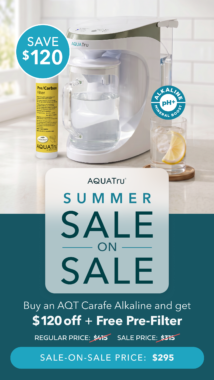
Buy an AQT Carafe and receive $120 off + Free Pre-Filter Replacement
Buy an AQT Carafe Alkaline and receive $120 off + Free Pre-Filter Replacement
Buy an AQT Carafe Smart and receive $120 off + Free Pre-Filter Replacement
Buy an AQT Carafe Smart Alkaline and receive $120 off + Free Pre-Filter Replacement
Buy an AQT Under the Sink and receive $120 off + Free Pre-Filter Replacement
Buy an AQT Under the Sink Alkaline and receive $120 off + Free Pre-Filter Replacement
Buy an AquaTru Classic and receive $125 off + Free Pre-Filter Replacement!
*The free Pre-Carbon filter will be automatically added and reflected in your cart AquaTru Shower: $99 in Matte Black, Chrome, and Nickel or $119 for Gold |
Orlando Mom Pro Tips for Water-Smart Families
If you want to take action without spiraling, here’s where I’d start:
- Test your water. A simple home water test kit is cheap and tells you a lot. If you’re on a well, this is non-negotiable. Even on municipal water, it’s worth doing.
- Pull your local water quality report. Every municipality is required to publish an annual Consumer Confidence Report. Google your city + “annual water quality report” — it’s free to read.
- Don’t just filter your drinking water — think about cooking water too. Pasta water, soup base, baby formula, smoothie ice cubes. It all matters.
- Refill kids’ water bottles from filtered water at home, not just whatever tap is closest at the field. The cumulative exposure matters more than the occasional sip.
- Be skeptical of “all filters are the same” messaging. Look for what a filter is certified to reduce — not just what it claims to do. Independent certifications (NSF/ANSI, for example) matter.
- Don’t panic — get informed. This isn’t about fear. It’s about knowing what’s in your water so you can make a real decision about what to do.
I’m always going to keep banging this drum: the foundations matter. Water, sleep, food, movement, sunshine, connection. The big stuff is the small stuff is the everyday stuff.
A Final Word From One Florida Mom to Another
If you’ve made it to the end of this article, you are now officially in the 65% of Americans who DID think about their tap water this year. Welcome, mama. Now do something with the information.
Test it. Read your report. Filter it. Drink more of it. Refill the kids’ water bottles. Make a real call about what your family is putting in their bodies a hundred times a day.
This isn’t fear-mongering. This is foundational health — the most foundational input we have.
You can’t out-supplement a polluted glass of water. But you can absolutely change the glass.
Cheers, mama. Stay hydrated — the right way. 💧
Research methodology: Talker Research surveyed 2,000 general population Americans with internet access; the survey was commissioned by Culligan International and conducted online between May 13 and May 18, 2026.